
YouTube has jumped on the “Teen Safety Settings” bandwagon. To be fair, they’ve been on it for a while, creating an entire webpage to defend their cause.
But now we have new “Teen Safety” parental controls for YouTube Shorts, allowing parents to set a timer for use (even to ZERO), which sounds like great news.
But is it really good news? We have to ask that question because it is so easy to believe their PR statements when they say they care deeply about teens and have added safety features for them.
We want to believe them.
We want to conveniently forget that the parental controls are voluntary for the teen.
And, we want to believe that even if it impacts their profits, they’ll do the right thing for kids.
As brave parents, we must be discerning and test everything (1 Thes 5:21-22). We cannot read a headline about YouTube ‘supporting teens’ and assume there is inherent safety. Let’s look critically at three of their claims.
Parents Firmly in Control
YouTube is offering parents ways to help teens be more intentional about what they watch.
They say:
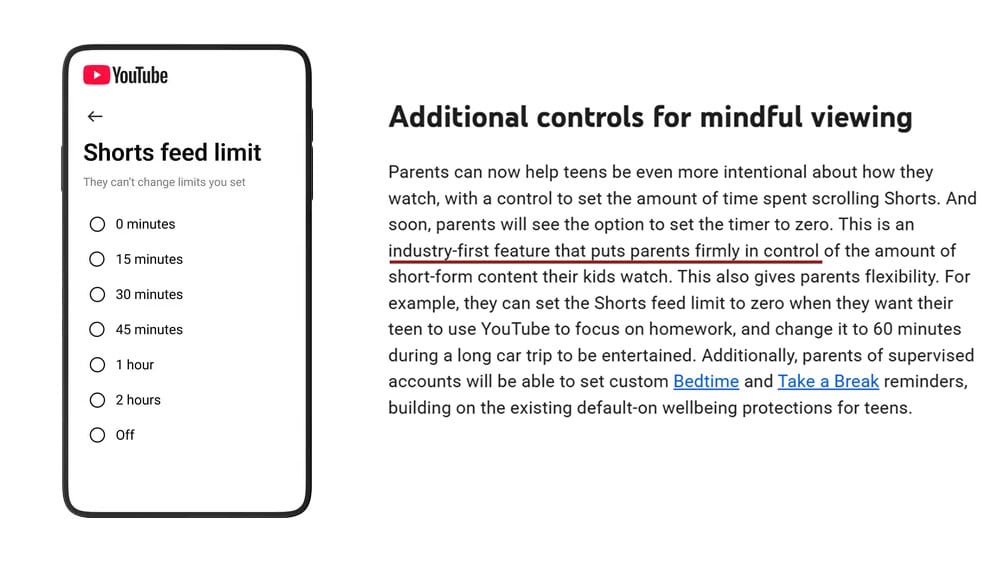
“This is an industry-first feature that puts parents firmly in control of the amount of short-form content their kids watch.”
On the surface, this sounds great – we parents love to have control! And now YouTube is giving us control over our kids’ use of the app. Before the confetti gets tossed, let’s consider some existing facts:
- 62% of children under 2 years old and 90% of teens watch YouTube
- YouTube Shorts launched in 2021, 5 years ago
- Short-form video research has revealed an association with poorer cognition, attention, inhibitory control, poor mental health, stress, and anxiety.
- Parents have long been concerned about their children seeing inappropriate video content and ads on YouTube.
So, based on these facts, what YouTube is really saying about its “industry first feature” is more like:
Now that we’ve got all the children hooked, let’s offer complicated parental controls that parents can attempt to use (but they probably won’t) so that the responsibility of children’s wellbeing falls back in parents’ laps instead of ours. So, parents – you are firmly in control. If your child watches YouTube for too long and “brain rots” or loses interest in everything that is good, healthy, and true, that isn’t a YouTube problem. It’s your problem because you didn’t utilize the controls that were offered.
You see, they use carefully crafted language that isn’t about safety, empathy, or true compassion; it’s about risk management. If they care so much, why didn’t they put safeguards or parental controls in place from the beginning of Shorts, or at any point during the last several years?
The reason is that they wanted teens to get hooked on Shorts. Why? Because they care more about profits than people.
Timer to Zero
Included in the announcement of parental controls is the ability to set the Shorts feed limit to zero. They say:
“Soon, parents will see the option to set the timer to zero….change it to 60 minutes during a long car trip to be entertained.”
Again, sounds great! But notice in their example (above picture): Set the feed limit to zero to focus on homework, and change it to 60 minutes to be entertained in the car, what is implicitly acknowledged:
- Teens cannot focus on homework if they know they have the ability to scroll Shorts
- Shorts is entertainment (not learning)
- Teens need to be entertained
Why should parents have to micromanage teens in order for them to focus on their responsibilities? Reality rarely allows for this. Why is there no expectation for conversation in the car? Entertainment is not a requirement.
And why, in their announcement, do they say “soon” parents will see the option to set it to zero? Why “soon” and not now? From a programming standpoint, this isn’t too hard for Google.
The reason is that they don’t really want parents to set their teens’ time to zero. Why? Because they care more about profits than they do people.
The Quality of the Content
YouTube has also set forth definitions of what constitutes high-quality and low-quality content for teens to consume. They say:
“…low-quality content that may be innocuous as a single video but could be problematic for some teens if viewed in repetition…”
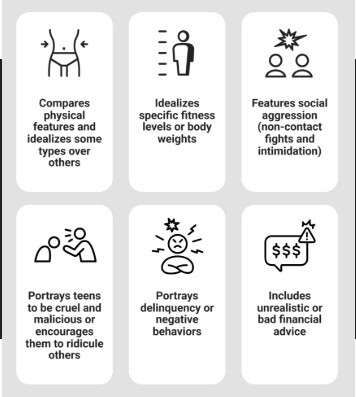
YouTube defines high-quality content as that which:
- Brings joy, fun, and entertainment
- Deepens interests and perspectives
- Builds life skills and experience
- Sources of credible information that bring about well-being.
Low-quality is:
- Narrow body standards and comparison
- Dangerous acts and negative behaviors
- Bullying, hate, and disrespect
- Wealth obsessions and misconceptions
- Aggressive and intimidating behavior
Taking all of this together, YouTube is acknowledging that algorithmically repeating, low-quality videos are “problematic” and harmful. The source of the problem, then, is both the design (algorithm shows repetitive content) and the low-quality content.
But, instead of addressing YouTube’s design features (algorithm, infinite scroll, and variable rewards), the company places the responsibility on creators to produce higher-quality content. And, of course, parents who should be firmly in control of their child’s content consumption.
Creators are warned that their channel’s performance may be affected because “We reduce repeated recommendations of low-quality content for teens.“ Now, technically, this should mean that teens see higher-quality content more often. But why can’t YouTube just step up and admit that its algorithm and design are problematic for teens? Why are they directing the problem at low-quality content – as if that will ever go away? Or why don’t they ban the low-quality content rather than reduce its repetition?
The reason is that they don’t want to change; they want everyone else to change instead. Why? Because, once again, they care more about profits than people.