

Artificial Intelligence is no longer something kids have to seek out. AI is in search engines, educational platforms, video games, social media platforms, voice assistants (Alexa), messaging apps, and now even toys.
Adults have the advantage of engaging with technology before generative AI was introduced in 2023. We remember life before ChatGPT, AI-generated images, and AI agents and can usually detect when AI has been added to something.
Children cannot. For them, AI is just another aspect of the digital world.
This is a problem because AI can disrupt childhood formation, training them to expect immediate answers, to outsource difficult tasks, and to believe chatbots are friends and confidants or, worse, preferable to humans.
Therefore, teaching children about AI and developing a framework to guide any use requires more than digital literacy, because, ultimately, these are issues of human formation.
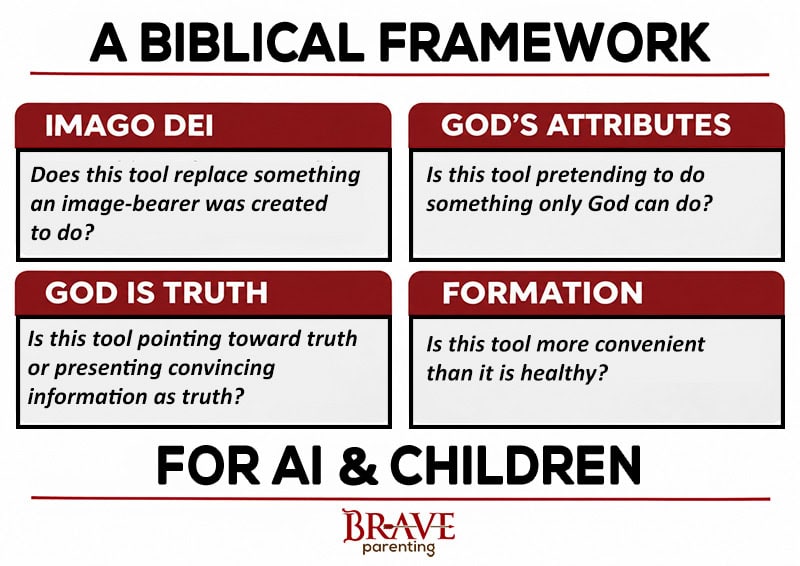
Here are four principles that should guide us:
1. Begin with the Imago Dei
Human beings are made in the image of God.
So God created mankind in his own image, in the image of God he created them; male and female he created them (Gen 1:27).
As image-bearers, humans are set apart as unique from the rest of creation. Specifically, this means that humans are not machines. We are not products to be optimized or enhanced with more technology. We don’t need more processing power for faster output.
Psalm 8 marvels at the distinction:
What is man that you are mindful of him, and the son of man that you care for him? Yet you have made him a little lower than the heavenly beings and crowned him with glory and honor (Ps 8:4-5).
Human dignity is given to us by God, whose image we bear. It is not earned or enhanced through works, intelligence, productivity, efficiency, achievement, or technology.
Yet AI is already whispering promises of superhuman capabilities, the elimination of undesirable manual work, and cures for diseases. More and more, culture is believing the idea that human limitations are problems that technology should eliminate.
Consider how this impacts children. They are already relentlessly measured and compared to their peers. What child wouldn’t jump at the offer of superhuman intelligence and optimization in order to measure up?
But children are not machines. Children are embodied souls created with inherent dignity and purpose.
This gives parents our first question when evaluating AI:
Q: Does this AI tool replace something an image-bearer was created to do?
Consider God’s command for us to love one another, encourage one another, bear one another’s burdens, confess to one another, teach one another, and live in community with one another.
An AI chatbot can simulate some aspects of human relationships, but it cannot fulfill the one-another commands.
The same concern applies to spiritual discipleship. AI can summarize a Bible passage, locate a verse, and answer factual questions about Bible figures, but it cannot disciple another image-bearer. Scripturally, discipleship is about learning, but not just information. It is about closely following, imitating, and adopting a discipler’s character, worldview, and habits.
Paul wrote to Timothy:
You have followed my teaching, conduct, purpose, faith, patience, love, and endurance (2 Tim 3:10).
There is a tremendous difference between retrieving information about the Bible and discipleship. If we don’t want image-bearers to be formed into machines, we cannot rely on AI to equip the saints.
2. The Attributes of God
The second part of the framework requires that we understand who God is.
God is omniscient: He knows all things.
God is omnipresent: He is everywhere all at once.
God is omnipotent: He possesses all power.
These are called the incommunicable attributes of God. They belong uniquely to God. He does not share them with man, animal, or machine.
Yet, AI can appear to imitate these attributes. Ask a chatbot anything, and it knows the answer. Open the app at 3:00 AM, and it’s always available. Ask it to generate an image, write a song, translate a language, summarize a book, solve a problem, analyze data, or write computer code, and it has the power to do it all in seconds.
Similar to how God spoke Creation into existence, you can type or speak a prompt, and an image, a song, code, homework answers, a recipe, or advice appears.
Isaiah 40:25-26 reminds us:
“To whom will you compare me? Or who is my equal?” says the Holy One. Lift up your eyes and look to the heavens: Who created all these? He who brings out the starry host one by one and calls forth each of them by name. Because of his great power and mighty strength, not one of them is missing.
Even for adults who understand how AI works, its capabilities still feel astonishing. Imagine how they appear to a child. How easily might they compare God with AI?
Therefore, parents should ask a second question:
Q: Is this AI tool pretending to do something only God can do?
Is it claiming unlimited knowledge? Is it promising power? Is it offering compassion and kindness beyond other humans? Is it positioning itself as an authority to be trusted without question?
A generative AI chatbot, an AI companion, and an AI assistant often masquerade as godlike.
We can know that AI has a place in God’s redemptive history, for He sovereignly reigns over all things. But we must be diligent to keep AI in its place and not allow it to deceive believers into thinking that it possesses the incommunicable attributes of God.
Part of reckoning with AI’s capabilities is teaching children to know the attributes of God. They must know who He is, as well as who we are, because AI technologies will constantly offer counterfeits.
3. God is Truth
Artificial Intelligence creates another challenge in its presentation as authoritative. It can generate (hallucinate) content with great confidence.
But confident authority is not the same as presenting Truth.
In our age of relativism, Christian parents must teach children that truth is not personal, it does not change, and does not come from whatever sounds convincing, receives the most likes, ranks the highest in search results, or appears instantly on a screen.
Truth is objective because all truth originates with God (John 14:6, 17:17). He is the eternal One (Ps 90:2), and all things are sustained by the power of His Word (Heb 1:3). All that has been created reveals God’s truth (Rom 1:20).
Truth is the foundation of all wisdom. Without truth, there is only information and knowledge.
Paul describes those who are easily deceived by false teachers as:
Always learning but never able to come to a knowledge of the truth (2 Tim 3:7)
Scripture tells us wisdom’s source:
The fear of the Lord is the beginning of wisdom. Proverbs 9:10
You see, AI can process a ton of information, but it cannot fear the Lord. As creations of man, AI models are not made in God’s image.
How easily will children be deceived by AI’s twisted truths, half-truths, and confident lies? In a culture where truth is often negotiable, children must learn that God is truth, the Bible is God’s Word, and God’s Word is inerrant (without error) and immutable (unchanging).
This establishes our third question:
Q: Is this AI tool pointing my child to truth or presenting convincing information as truth?
This question extends beyond chatbots because algorithms can shape children’s perception of reality every day.
Technology doesn’t have to explicitly say, “this is true,” to shape what children believe. Algorithms on social media determine which images, ideas, products, people, and lifestyles are shown. A video game algorithm can use variable rewards, levels, experience points, streaks, and achievements to convince children they are good and that more play is beneficial. Recommendation systems in streaming services can quietly teach what is desirable, important, beautiful, normal, and worthy of attention.
Christian parents must teach children not to passively consume information and entertainment, but to test it. Does it align with God’s truth?
Testing is accomplished through examining the Scriptures and through counsel with mature, trusted believers. In the age of AI, this is becoming a lost practice.
4. The Process of Formation
The fourth and final part of this framework may be the most important. Formation helps us understand why AI poses a unique risk to children.
Human beings are formed through struggle. Throughout the Scripture narratives, we see that growth comes through patience, discipline, suffering, perseverance, responsibility, failure, correction, and endurance. Abraham, Jacob, David, Daniel, Jonah, and Peter are all notable examples of being formed through struggle.
James writes:
Consider it pure joy, my brothers and sisters, whenever you face trials of many kinds, because you know that the testing of your faith produces perseverance. Let perseverance finish its work so that you may be mature and complete, not lacking anything (James 1:2-4).
Paul writes to the Romans:
We also glory in our sufferings, because we know that suffering produces perseverance; perseverance, character; and character, hope (Romans 5:3-4).
We can surmise that difficulty is not always something to eliminate. Often, difficulty is doing the work of formation.
This presents quite a challenge for today’s parents, as there are countless ways to remove obstacles, ease challenges, and rescue children from potential discomfort. And it’s socially acceptable to do so.
Forget your homework? I’ll bring it.
A teacher gave you a bad grade? I’ll talk to him.
Bored? Here’s a screen.
Can’t think of what to write? Ask AI.
Can’t remember your daily tasks? Alexa will help.
Lonely? Here’s a chatbot.
A frictionless childhood is not a healthy childhood.
There is divine purpose in our human limitations. Children need to experience those limitations in order to know they can persevere despite them.
They need to wrestle with a math problem. They need to sit with a blank page until they figure out how to organize their thoughts. They need to struggle through relationships with imperfect image-bearers. These experiences form them.
This brings us to our fourth question:
Q: Is this tool more convenient than it is healthy?
Will it remove work my child needs to learn to do on their own? Will it eliminate productive struggle? Will it only free up time that will be wasted on screen-based entertainment?
While convenience is not inherently bad, its ultimate value must be considered. Convenience that removes friction, struggle, and endurance is not an ally of your child’s formation or your discipleship.
Even when AI technologies promise to remove every source of friction, Christians must commit not to allow convenience to be our highest good.
Two Necessary Points of Clarity
Before applying this framework, it is helpful to recognize the following:
(1) Children Are Not Experts
An important distinction exists when discussing AI: adults and children are not the same.
In many professions, adults are using artificial intelligence for productive purposes. A competent journalist can use AI as an editing or research assistant because they already know how to write and research. Experts can offload portions of work they already know how to do.
Children, however, are not experts.
Children are learning how to think, communicate, create, work, relate, worship, exercise self-control, solve problems, and understand the world.
Giving a child AI because “they’ll need to know how to use it someday” misunderstands childhood. We don’t teach children to use every adult tool just because they might encounter it as adults. Instead, we develop the human capacities necessary for lifelong learning, new skills, and the wise use of tools.
The rush to prepare children for the AI future may actually undermine the very abilities they will need most.
(2) We’ve Seen This Experiment Before
Across the globe, we have already conducted an enormous technological experiment that should give us some insight into how AI will shape children.
During the rise of social media, adults repeatedly heard: “This is the way the world is; this is how kids communicate now; they’ll feel left out without it.”
And so, technology designed for adults was handed to children.
It was nearly a decade before society began seriously confronting what social media use meant for relationships, body image, sexuality, mental health, and childhood development.
We should not repeat the same mistake simply because the technology has changed. Besides, the AI systems today will likely look primitive by the time today’s elementary-aged children reach adulthood.
New and novel does not mean necessary.
Application
To apply this biblical framework, parents do not need to be AI experts. With every new app or integration, return to these four principles:
1. Imago Dei
Humans are uniquely made in God’s image. Ask whether the AI tool is replacing something image-bearers were created to do.
2. God’s Attributes
Omniscience, omnipresence, and omnipotence belong to God alone. Ask whether the technology is masquerading as something all-knowing, all-powerful, or worthy of obedience.
3. God’s Truth
God is truth, and the fear of the Lord is the beginning of wisdom. Ask whether the technology helps your child recognize truth or only creates a convincing imitation of it.
4. Formation
Humans grow through patience, struggle, work, discipline, weakness, and perseverance. Ask whether the technology supports healthy formation or removes the very difficulty your child needs in order to mature.
The End Decision
When these principles are applied specifically to childhood, there are no compelling reasons for children to use AI tools independently.
This conclusion may sound extreme in a culture rushing toward AI adoption, but no supposed benefit outweighs the formative risks. And every supposed benefit can be better accomplished through a parent, teacher, book, conversation, real-world experience, or another non-AI source.
Childhood does not need technological enhancements. Childhood needs discipleship. Children need the intellectual, relational, moral, and spiritual formation that will eventually allow them to use powerful tools wisely.