
There are always new social sharing apps popping up, trying to gain traction with the youngest generation. Many don’t make it far, but Yope is growing, now boasting 2.2 million users per month.
In this guide, we’ll cover the basics every parent needs to know and then consider the app from a biblical worldview.
#1 What is Yope?
Yope is a photo-sharing app for private groups of friends.
Their app description states, “on Instagram, you’re performing. on Yope, you’re just living.” It states that Yope was created because social media became too fake with filters, edits, likes, and all the noise. The core idea of the app is that there is no “unknown audience” you are posting for – only the people you care about.
Shared photos within your group appear instantly on friends’ lock screens and widgets. This means that you don’t have to open the app in order to stay connected.
There are no algorithms or feeds, but built-in chats let you communicate with your friends about their posts (or anything else) without traditional texting.
#2 Positive Features
Shared photos are only seen by accepted friends.
While there are no public feeds, follower counts, or explore/discover pages, the “home page” consists of a TODAY block for your pictures and a YOUR FRIENDS block for their pictures. The TODAY block encourages you to take pictures throughout the day (“UPDATE DAY”), which friends can then scroll through.

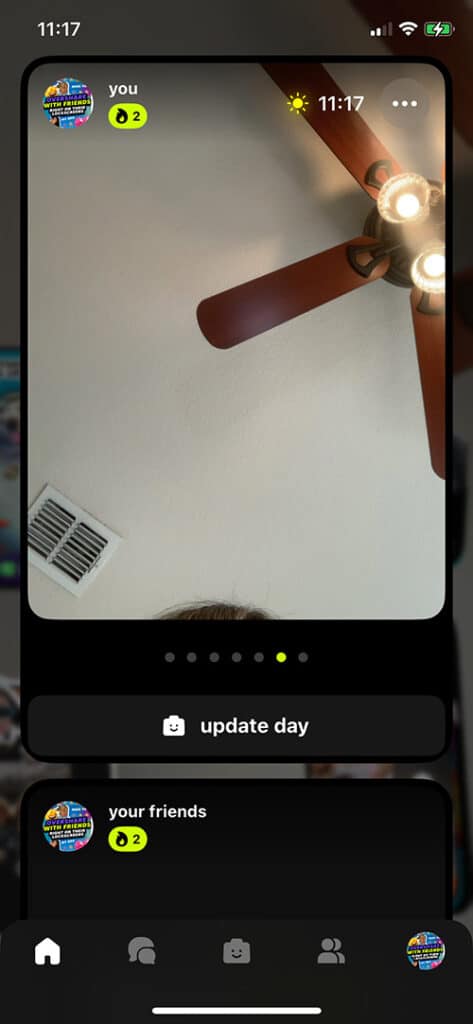
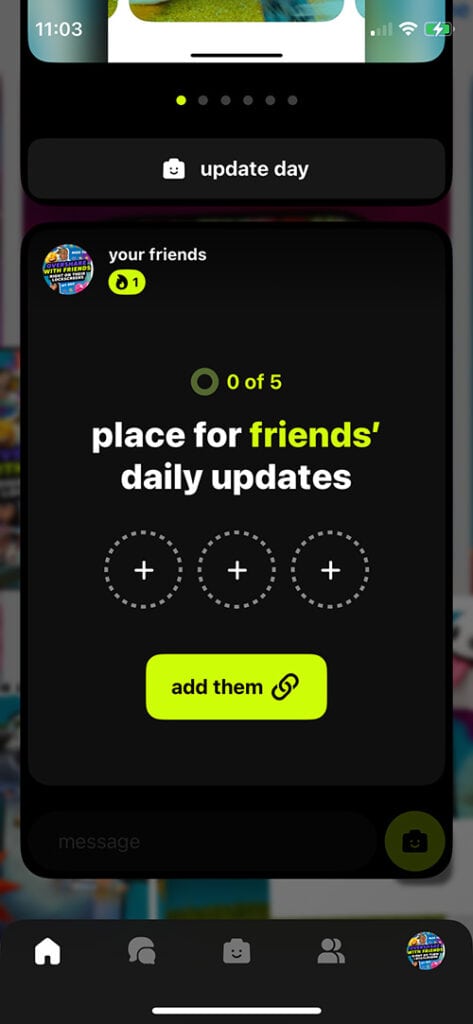
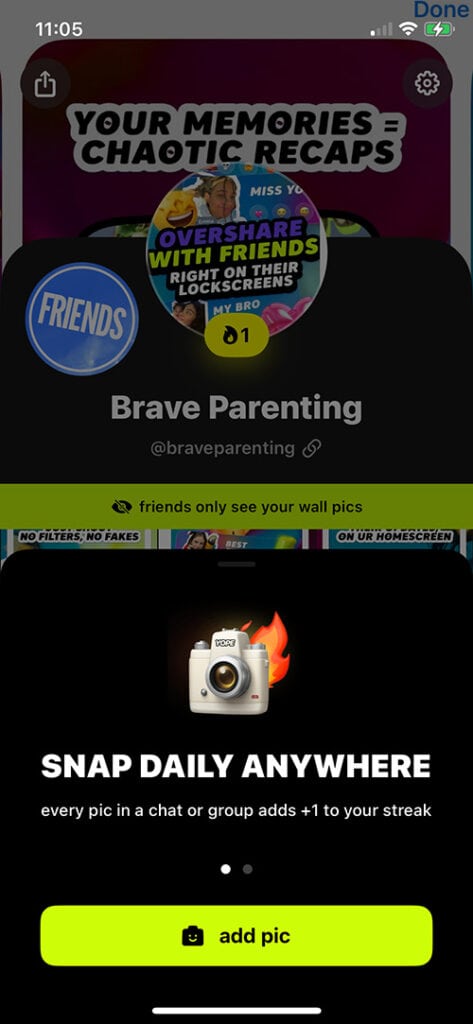
Fast photo sharing, to limit filters/edits.
This does minimize the ability to curate and filter life (an ever-present temptation, even among friends on social media). Yet, they simultaneously encourage users to overshare with friends. Aren’t unfiltered photos in excess as overwhelming as a few with filters?
#3 Negative Features
Streaks to keep users engaged.
They claim that “streaks make friendships stronger – post together, grow together.” Not only do streaks inherently breed compulsion, anxiety, and constant connection, but they also dilute what authentic communication is meant to be. Being harassed by notifications to not lose a streak by sharing a photo within the group makes for a shallow and contrived connection.
Nevertheless, the streaks appear to be a personal motivator as well, as your own posting of pictures is tallied and tracked.
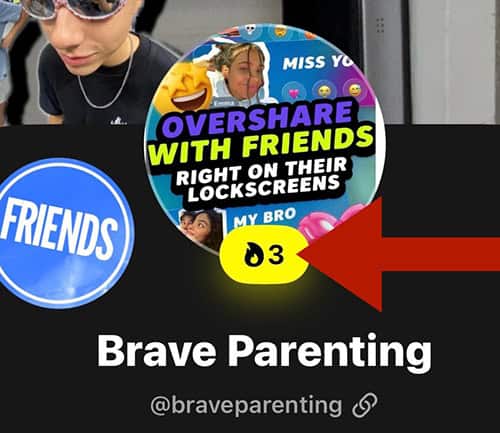
Tally of Photos
Attached to your profile picture is a flame emoji with the number of photos you’ve taken/shared on the app. Why? Seriously – why is this here? Other than to breed a sense of competition with others…
Chaotic Recaps
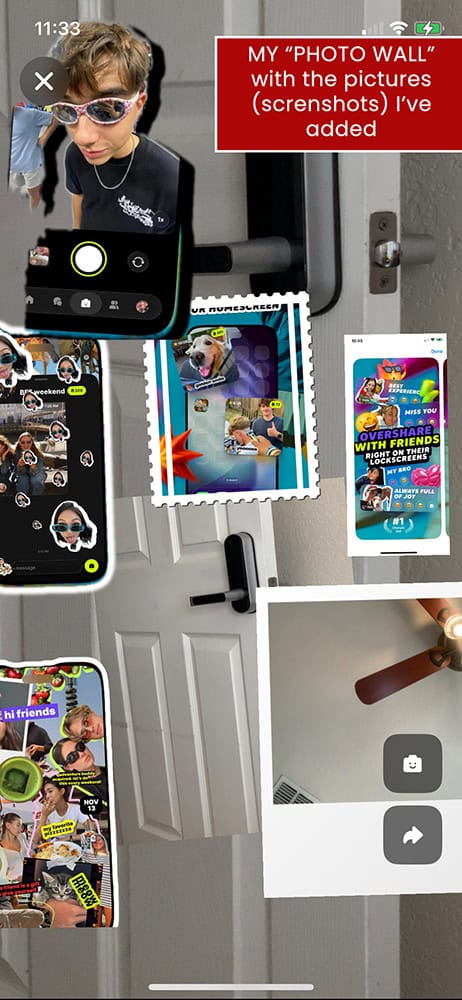
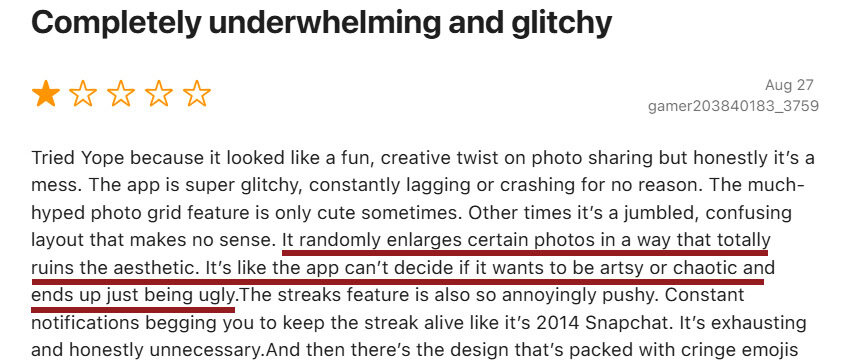
Yope’s “photo wall” uses machine learning to cut out and splice images shared in the group into a giant photo collage. They refer to this themselves as “Your Memories = Chaotic Recaps.”
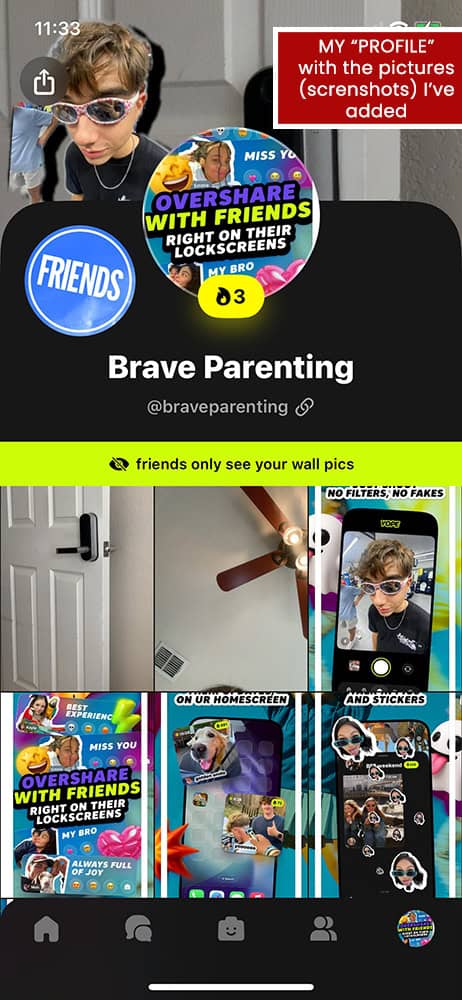
Below: (Left) App Store Photo (Center) I added a picture of the ceiling fan and a door to the screenshots I’d already added to my profile. (Right) The app generated my “chaotic recap” of the day.

Calling this feature out as ugly and unnecessary risks sounding like out-of-touch Gen-Xers…so we’ll let just this app review describe it:
Data Collection
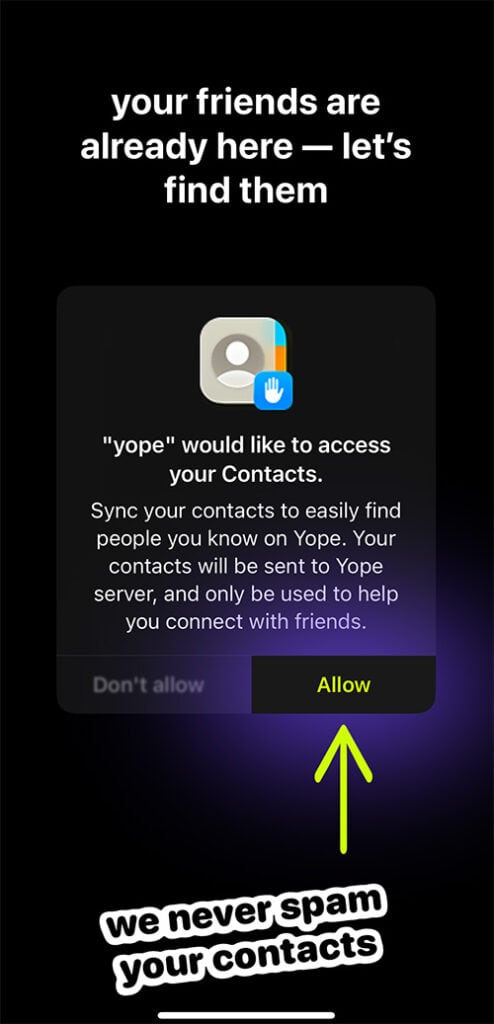
Yope requests access to your first and last name, phone number, phone contacts, your location, your photos, and media files. Considering they also encourage oversharing, it is a lot of photographic artifacts of a teen’s life they have access to.
Usernames
In addition to a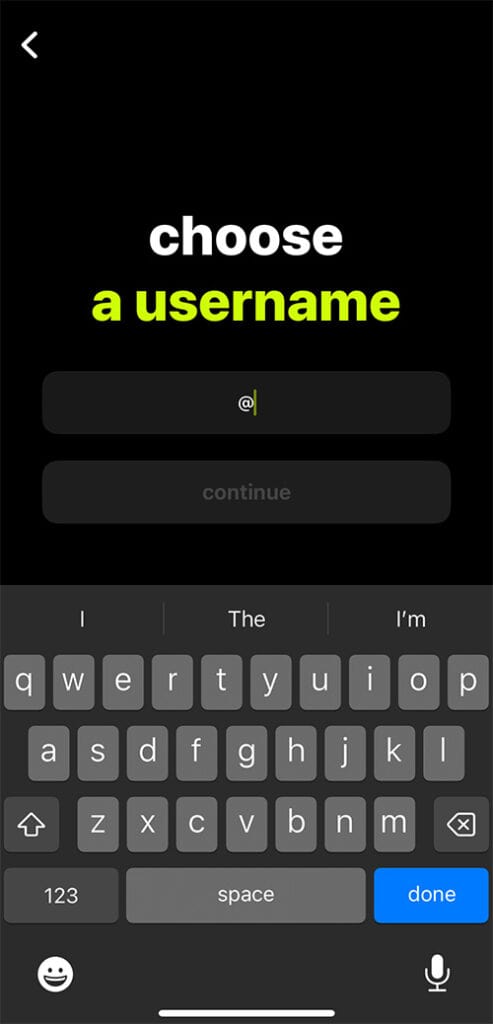 sking for your first and last name, Yope has every user create a username.
If the app is for sharing between friends and family, what’s the point of a username? If you’re allowing access to your contacts, aren’t these the friends and family who know you (and you know them) since you have their contact?
It would seem as though the purpose of the username is to share it as a “handle” so others can search for you. Just like young people say, “What’s your snap?” now they’ll ask, “What’s your yope?” In this way, it’s not just about friends and family – if others can search for your handle, then anyone can request to be your friend.
And this is how predators find new young victims.
Vanishing Photos
According to a TechCrunch article in February 2025, the app developers hope to add vanishing photos with a lock-screen timer.
Now this is getting a little too Snapchat-like.
#4 Growth and Popularity
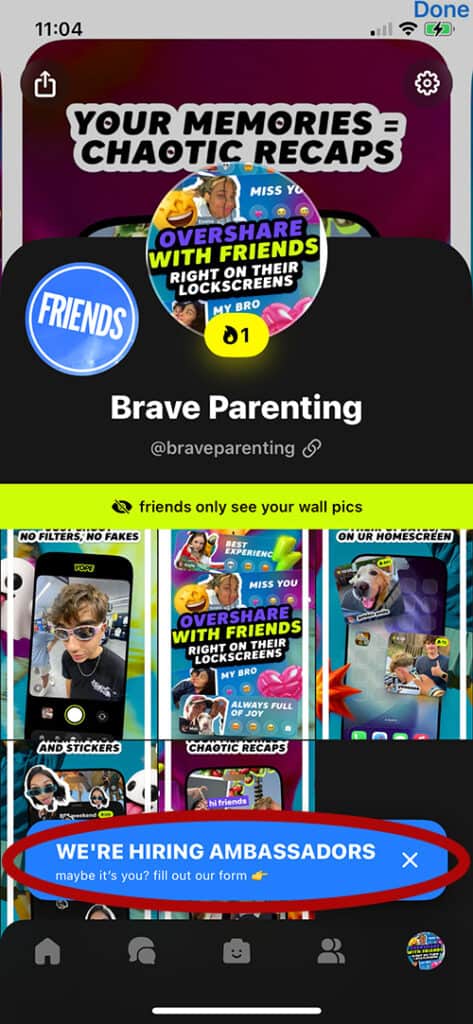
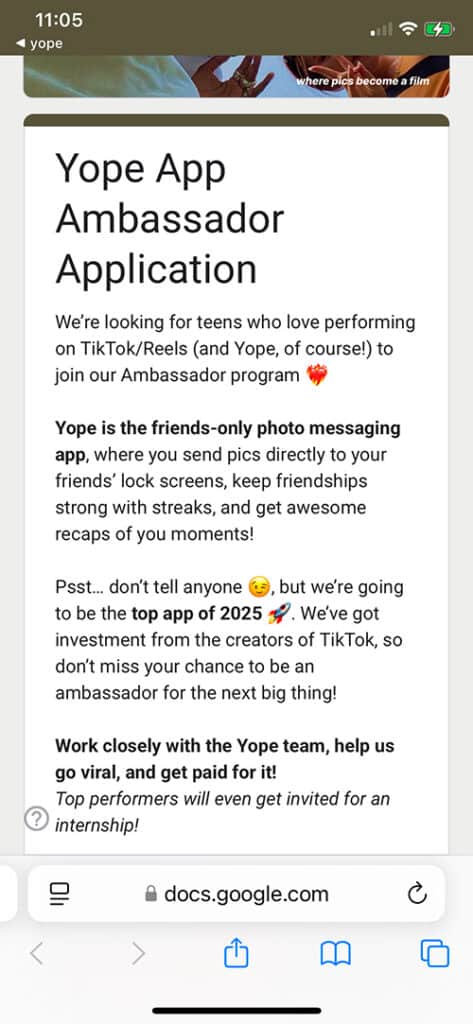
Yope has built an ambassador program to drive awareness of the app. By providing payouts to “power users” who post about the app on other social platforms like TikTok and Instagram, the app has gained visibility among Gen Z and Gen Alpha. Yope said that ambassador videos have had over 56 million views.
Ostensibly, this isn’t that impressive. Teens who already use TikTok and Instagram and then promote Yope for payment aren’t exceptional sources to attest to the app’s value.
Another boost in Yope’s popularity stems from the Australian Social Media Age Minimum, effective December 10, 2025. Teens under 16 who were banned from popular social media apps like Instagram, Snapchat, and TikTok began looking for new platforms to migrate to. Yope was one of them.
The more Yope soared up the charts in downloads, the more noticeable it became to the Australian government. On December 2, Yope and (ByteDance-owned) Lemon8 were notified by Australia’s e-Safety Commission that they should “self-assess” to determine whether they fall under the new laws restricting social media access.
With zero algorithms or public feed, it seems that, as it operates right now, Yope is not at risk of inclusion in the ban.
#5 Rating, Recommendation, & Biblical Perspective
Apple’s App Store: 4+
Google Play: Everyone
Yope: 13+; users between 13-18 years old can use only with the involvement of a parent or guardian.
Brave Parenting: 16+ with proven responsibility and maturity
Yope, at the time of this writing, isn’t the worst photo-sharing app. The problem is it’s not likely to last. The app will need to generate revenue, so they’ll likely add subscription-based features, micro-transactions, or ads. Sadly, this is the way the free-to-use app economy operates.
Nevertheless, there remains little reason to engage with friends this way. Streaks are poor motivation for communication and sometimes – a lot of times – friendships actually grow stronger without constant connection. Realistically, we must recognize that a friend can still screenshot or screen-record shared photos and share elsewhere for bullying, gossip, or mockery.
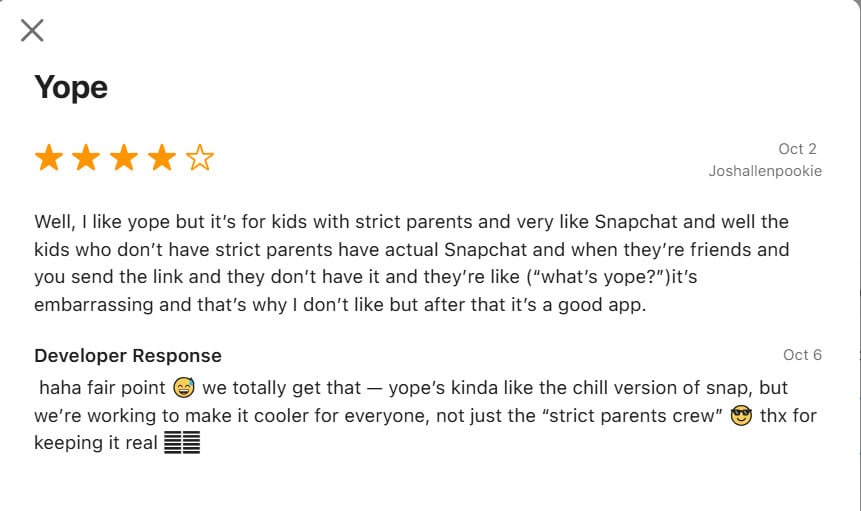
For teens who desperately want Snapchat (but you won’t allow it – good for you!), Yope is a possible alternative. Humorously, an app review commented exactly this:
If you are considering allowing your 16+ teen to use the Yope app on their phone, we highly encourage you to join the app as well and initiate a trial period. You can bring in other family members if desired (or if they’re willing). Doing so allows the app to be experienced without any pressure from peers. Your teen can engage with the app with trusted family and decide whether it’s worth keeping.
Also, all standard rules of prudence, moderation, and respect must be expected with its use. No inappropriate pictures, no accepting unknown people as friends or joining groups with unknown people, and no lock-screen notifications after set time in evening, and no phones in bedrooms overnight at a bare minimum.
Biblical Perspective
Social media has become the bane of parents worldwide. To restrict it is to “prohibit a child’s freedom of self-expression and connection”; to freely allow it is to risk their self-worth, innocence, mental health, and safety. To land anywhere in between where you allow an app and promise to monitor their activity is hard – if not impossible. Parents in all three camps are criticized and judged for their parenting.
The problem is the variance in outcomes. Some teens can use social media with wisdom and temperance. Others lose confidence in competition and comparison. Some are solicited into conversations with strangers. Others are ensnared with radical ideas. Some find drug dealers. Others find fame. Some find community. Others become isolated.
There is no guarantee social media will provide a net benefit, and no insurance if it leads to destruction.
Social media, on its most surface level of social sharing and connection, is neutral. Beyond its framework, however, there is nothing neutral or predictable about how these platforms can impact young hearts and minds. It’s a concoction of algorithms, advertisements, life circumstances, age, IQ, sinful humans, evil desires, anonymity, competition, comparison, performance, and greed. Stir it all together, serve it up, and every cup will taste different to each person.
So then, how is any parent to know whether one app or another is right, good, or healthy for their teen?
For Christian parents, it begins with a resolve in our hearts to make no provision for the flesh (Rom 13:14) and to be aware of where the devil prowls (1 Peter 5:8) so that we can stand against his evil schemes (Eph 6:11). Our mission must be to discern the will of God, not to make our child happy.
When this is our heart posture as we evaluate whether or not a social media app is right for our teen, the Holy Spirit will lead us in truth (John 16:13). You won’t have to make justifications or accommodations for the app’s use. Either it poses little to no risk to the teen’s spiritual, mental, physical, and emotional health, or it poses much. It either stands on the line of sin and evil desires, or it stands blameless. Likewise, you will either recognize pure motives in your teen or impure desires for the things of this world.
In other words, you will know whether to allow it.
Prohibiting an app as a means of controlling their exposure to the dangers of social media isn’t a wrong motive, nor does it demonstrate a lack of trust in God’s sovereignty. It aligns with what Scripture calls “the wisdom that comes from heaven” (James 3:17).
With that said, taking the time to disciple your teen to discern for themselves the value versus risk of each app is equally wise.